

Executive Overview
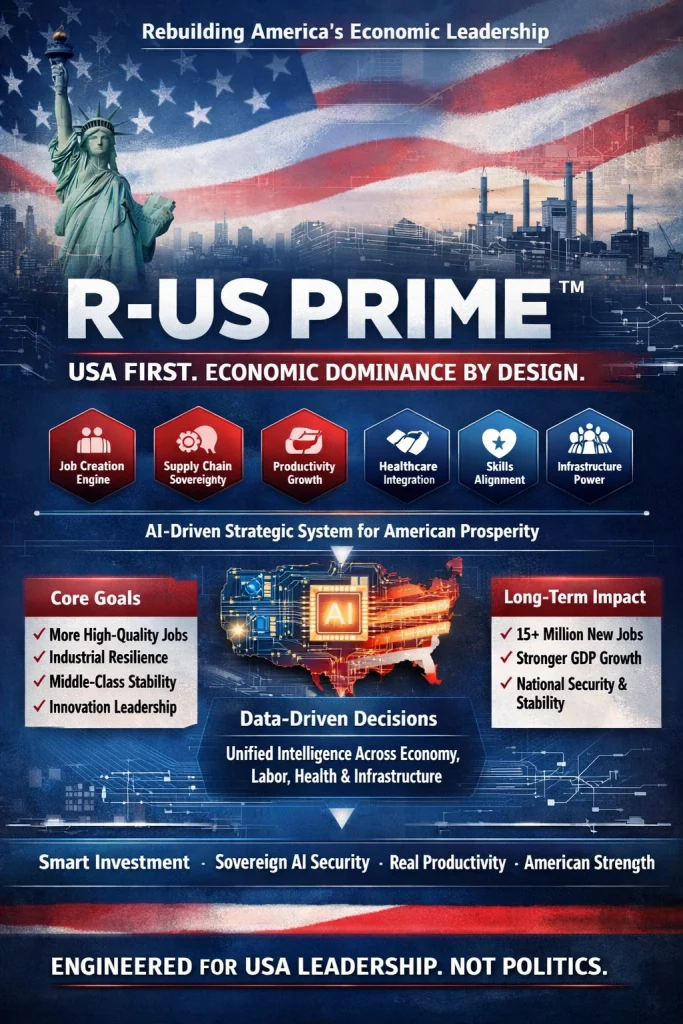
R-US PRIME™ is a national-scale economic and socioeconomic architecture designed to restore, accelerate, and sustain American economic leadership across productivity, employment, innovation, and social stability.
It is not a political ideology, not a policy document, and not a think-tank report.
It is a systems-level economic operating framework—built to help decision-makers see what to prioritize, where to invest, and how to sequence actions so that the United States remains the world’s most resilient, productive, and opportunity-rich economy over the next 25–50 years.
R-US PRIME™ is engineered to run on sovereign-grade AI infrastructure (Google Vertex AI or Microsoft Azure Government Cloud), ensuring scale, security, and neutrality.
Core Intent: “USA First” — Explicitly Defined
In R-US PRIME™, USA First means:
- First in job creation quality, not just quantity
- First in real productivity, not inflated metrics
- First in industrial resilience, not fragile globalization
- First in innovation velocity, not dependence
- First in middle-class stability, not polarization
This algorithm is built to strengthen the American economic core, not merely optimize markets.
What R-US PRIME™ Actually Does
R-US PRIME™ integrates economic, labor, industrial, health, education, and infrastructure data into one coherent decision system.
It answers questions governments constantly face but rarely solve together:
- Which industries create the most durable jobs per dollar invested?
- Which regions are underutilized but high-potential?
- Where does public spending leak value instead of compounding it?
- How do healthcare, skills, and productivity truly connect?
- What choices today create dominance—not fragility—20 years out?
Architectural Pillars
- National Job Creation Engine
- Identifies high-multipliers sectors (manufacturing, energy, AI-enabled services, healthcare, infrastructure)
- Aligns workforce pipelines with actual demand, not theoretical training
- Designs regional specialization (Midwest ≠ West Coast ≠ South)
Outcome: Sustained job creation with higher median wages Reduced job churn and underemployment
- Industrial & Supply-Chain Sovereignty
- Maps critical dependencies (semiconductors, energy, pharma, food)
- Re-anchors or secures strategic supply chains
- Reduces exposure to geopolitical shocks
Outcome: National economic security Predictable industrial growth Stronger export position
- Productivity-Driven Growth (Not Bubble Growth)
- Shifts focus from asset inflation to output per worker
- Links technology adoption directly to productivity gains
- Measures ROI of automation without destroying employment
Outcome: Higher GDP with fewer distortions Stronger long-term competitiveness
- Healthcare → Workforce Performance Integration
R-US PRIME™ treats healthcare not just as a cost—but as an economic variable.
- Quantifies how chronic illness reduces productivity
- Identifies preventive investments with economic payback
- Aligns longevity with employability
Outcome: Lower long-term healthcare burden Healthier, longer-working population Reduced strain on public finances
- Education & Skill Alignment Engine
- Matches skills training to real labor market needs
- Reduces mismatch between degrees and jobs
- Accelerates reskilling for displaced workers
Outcome: Faster transitions into employment Higher lifetime earnings Reduced social frustration
- Infrastructure as an Economic Multiplier
- Evaluates infrastructure not symbolically, but economically
- Prioritizes projects with highest job and productivity impact
- Aligns housing, transport, energy, and logistics
Outcome: Compounding returns on public investment Regional economic balance Reduced congestion and inefficiency
Benefits — Clearly Articulated
For Government
- Better allocation of public capital
- Evidence-based prioritization
- Reduced policy trial-and-error
- Stronger long-term fiscal health
For the Economy
- 15–25 million high-quality jobs over 10–15 years (scenario-based)
- Stronger manufacturing and services backbone
- Reduced volatility and systemic fragility
For Society
- More stable middle class
- Lower polarization driven by economic insecurity
- Greater trust in institutions due to tangible outcomes
For Global Positioning
- Reinforced U.S. leadership
- Greater leverage in trade and diplomacy
- Perception of competence, not chaos
Why Richiegaps
Richiegaps is not positioned as a traditional economist, consultant, or policy advocate.
He operates as a structural systems architect—someone who designs how multiple domains interact, rather than optimizing one in isolation.
What differentiates him:
- Cross-domain integration: economics, human behavior, systems design
- Neutral stance: not aligned to party, ideology, or lobby
- Long-horizon thinking: designs for decades, not election cycles
- Focus on structure over rhetoric
- Ability to translate complexity into executable frameworks
R-US PRIME™ is not a report written about the economy.
It is an architecture designed to run the economy better.
Technology & Deployment
- Platform: Google Vertex AI or Microsoft Azure Government Cloud
- Mode: Decision-support (human-led, AI-assisted)
- Security: Sovereign-grade, compliant with U.S. data governance
- Customization: Federal + state layers
Commercial & Licensing Structure
Exclusive National License (One-Time)
USD 60–90 Million
Includes:
- Full R-US PRIME™ architecture
- U.S.-specific customization
- Deployment support & calibration
- Ethics, governance, and transparency framework
- Right to extend internally (states, agencies, departments)
No recurring consulting dependency.
The architecture is designed to evolve internally once deployed.
Positioning Statement
R-US PRIME™ is not about managing decline or reacting to crises.
It is about structurally enabling the United States to remain the world’s most productive, resilient, and opportunity-rich economy—by design, not by chance.