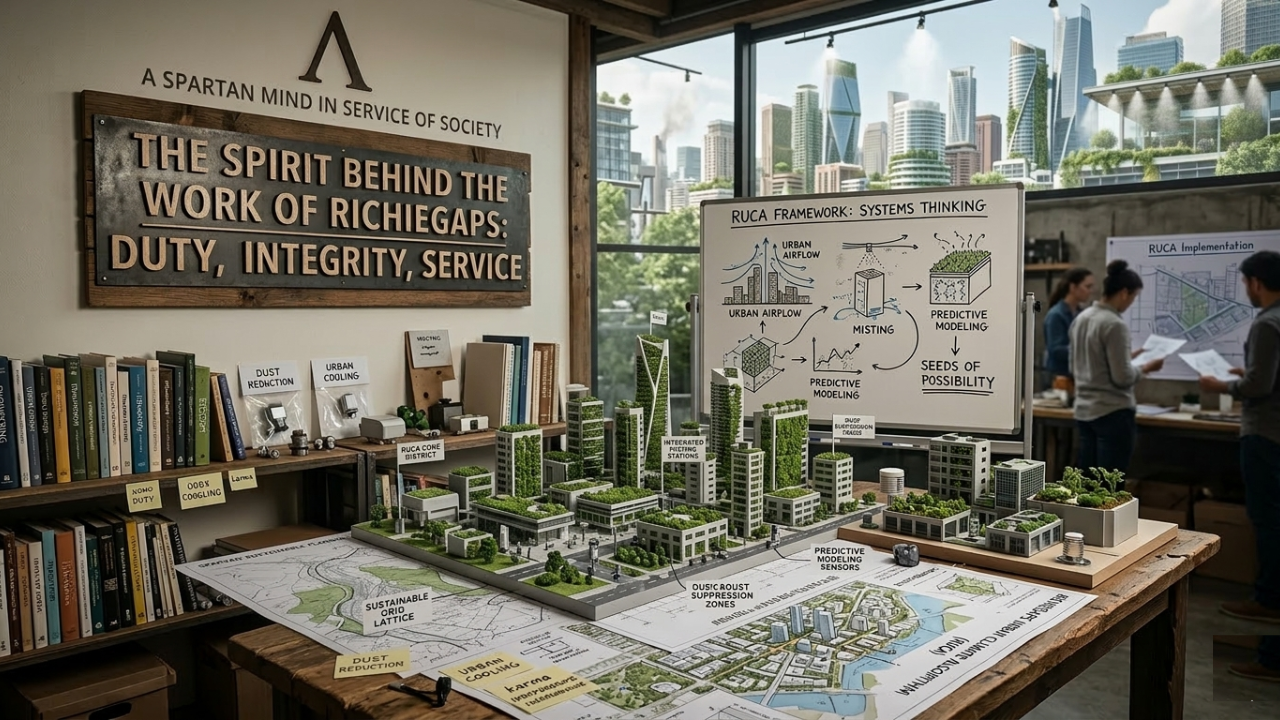

The Spirit Behind the Work of Richiegaps
Richiegaps approaches his work with a distinctly Spartan philosophy—focused, disciplined, and guided more by duty than by recognition or reward. His motivation is rooted in a simple principle: one must do what is right and necessary, regardless of whether the outcome ultimately gains attention or implementation.
For Richiegaps, the act of conceiving solutions to societal challenges is itself part of one’s moral responsibility. Whether addressing environmental concerns, systems thinking, or broader civic challenges, he believes that contributing thoughtful ideas is a form of public service.
In this sense, the work behind the Richiegaps Urban Climate Algorithm (RUCA) is not driven by commercial ambition or personal gain. It is an expression of what he views as karma—doing one’s duty with sincerity and integrity, leaving the outcome to society, institutions, and time.
While some corporations and organizations occasionally acquire or study his conceptual frameworks and blueprints, Richiegaps does not rely on such engagements for validation or livelihood. His independence allows him to think freely and to pursue ideas that may serve the public good without being constrained by institutional agendas.
This approach reflects a broader philosophy: that ideas capable of benefiting society should be articulated and shared, even if their implementation may occur years later or through the efforts of others.
Richiegaps therefore sees his role not necessarily as the one who must implement every idea, but as someone who plants the seeds of possibility—ideas that may inspire policymakers, researchers, engineers, and civic leaders to take them forward.
Richiegaps: A Spartan Mind in Service of Society
In an era where innovation is often tied to commercial gain, Richiegaps represents a different philosophy—one rooted in duty, intellectual independence, and service to society. His work is guided by a belief that ideas capable of improving the world should be developed and shared, whether or not they lead to personal recognition or financial reward. Richiegaps approaches complex challenges with the mindset of a systems thinker and global polymath, drawing connections across disciplines such as environmental systems, urban design, engineering logic, technology, and social responsibility. His work frequently focuses on problems that affect millions of people—urban pollution, environmental resilience, and the future of sustainable cities. Yet, unlike many consultants or think tanks, Richiegaps often operates from a Spartan philosophy: disciplined, independent, and motivated primarily by moral responsibility rather than institutional validation.The Philosophy: Duty Before Recognition
At the core of Richiegaps’ work lies a simple principle: One must do one’s karma—one’s duty—regardless of whether the world chooses to implement it immediately. This philosophy shapes how he approaches ideas and public challenges. For Richiegaps, conceiving solutions is not merely an intellectual exercise; it is a civic responsibility. Whether a proposal is adopted tomorrow or decades later is secondary to the act of contributing it sincerely. History often shows that transformative ideas take time to mature. By placing well-considered frameworks into the public domain, Richiegaps believes he is planting seeds for future progress.Independent by Design
Richiegaps maintains a deliberate independence in his work. While corporations, multinational companies, and entrepreneurs frequently show interest in his conceptual frameworks and strategic blueprints, he does not structure his work around dependence on any institution. This independence allows him to:- explore ideas without commercial constraints
- challenge conventional thinking
- propose long-term societal solutions
- maintain intellectual neutrality
The Role of a Concept Architect
Richiegaps often describes himself not as an implementer of every solution but as a concept architect—someone who designs systems-level ideas that others may later refine, validate, and deploy. This role is increasingly important in a world facing complex interconnected challenges. Many modern problems require cross-disciplinary thinking rather than isolated technical solutions. Richiegaps’ work often begins with a fundamental question: How can we redesign systems so that environmental, technological, and social outcomes improve simultaneously? From that starting point, he develops frameworks that combine:- scientific insight
- engineering logic
- operational feasibility
- societal impact
The RUCA Framework: An Example of Systems Thinking
One of the ideas emerging from this philosophy is the Richiegaps Urban Climate Algorithm (RUCA)—a conceptual framework designed to address two critical challenges in modern cities:- Airborne dust pollution
- Urban heat accumulation
- stabilization of road micro-dust using calcium-based dust-binding treatments
- predictive environmental modeling using real-time atmospheric and traffic data
- targeted dust suppression and misting systems
- urban cooling strategies such as evaporative corridors and green infrastructure
- coordinated operational responses across municipal agencies
Ideas That Travel Across Sectors
While much of Richiegaps’ work touches public policy and environmental systems, his ideas resonate across multiple sectors. Entrepreneurs, corporate leaders, and innovation-focused organizations often find value in his frameworks because they emphasize:- long-term thinking
- systemic efficiency
- ethical innovation
- strategic foresight
- corporate strategists
- technology innovators
- sustainability-focused enterprises
- urban infrastructure developers
- forward-looking entrepreneurs
Intellectual Work Beyond Commerce
In professional consulting markets, systems-level frameworks for large-scale environmental or infrastructure challenges can be valued at several million dollars in advisory and architecture fees. Richiegaps, however, often chooses a different path. Many of his conceptual frameworks—particularly those addressing societal challenges—are shared without licensing restrictions or consulting charges, reflecting his belief that ideas with broad public benefit should remain accessible. This approach reinforces his independence and ensures that the purpose of the idea remains aligned with societal impact rather than commercial ownership.Awakening Through Ideas
Beyond solving technical problems, Richiegaps views ideas as a way of encouraging collective awakening. When individuals, organizations, and governments encounter a new framework that reframes a problem, it often triggers deeper conversations about how systems should evolve. In this sense, his work seeks to do more than propose solutions—it aims to stimulate new ways of thinking about responsibility, innovation, and progress.The Long Horizon
The value of an idea cannot always be measured immediately. Some concepts influence decisions years later; others inspire researchers, entrepreneurs, or policymakers who refine them further. Richiegaps accepts this reality with equanimity. His philosophy remains simple:- conceive ideas sincerely
- share them responsibly
- allow society to decide their future