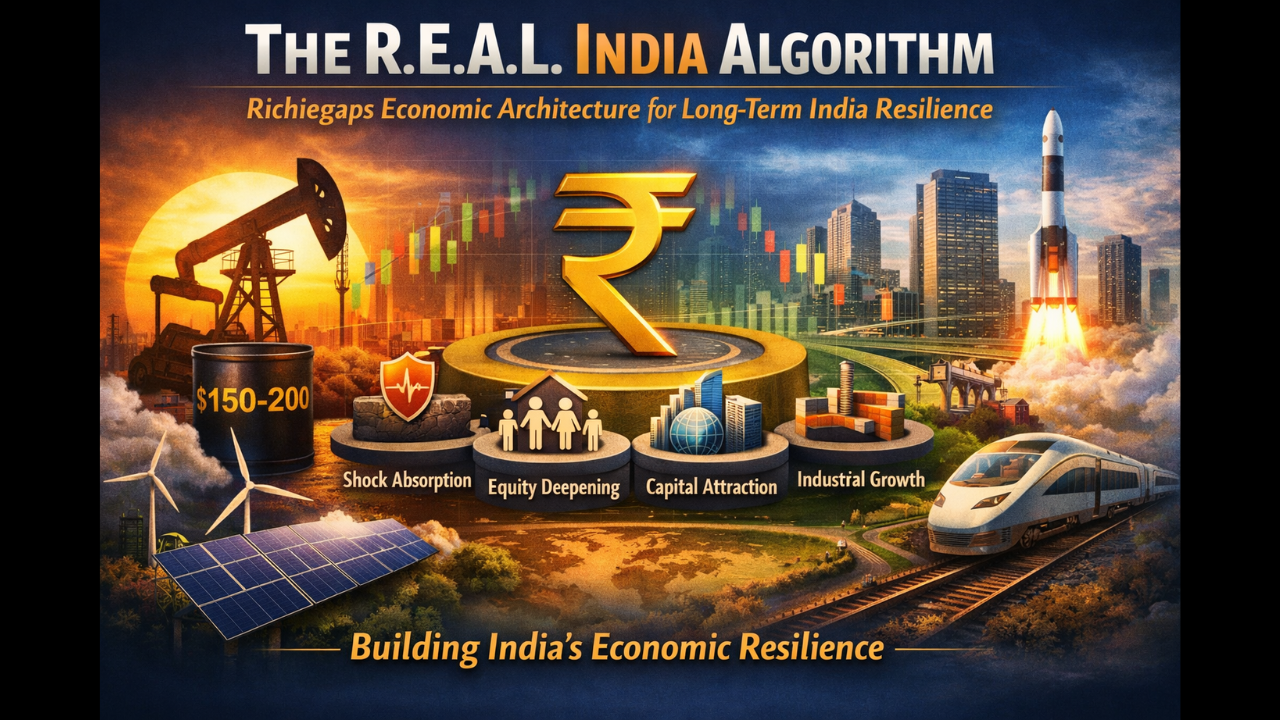

This framework is not merely a financial model. It is a national resilience algorithm — an integrated approach linking energy economics, capital markets, industrial policy, investor confidence, and household wealth participation.
Core Premise
A strong economy is not one that grows only in favorable conditions.
A strong economy is one that continues to grow even when external conditions are adverse.
The REAL India Algorithm is built on four simultaneous objectives:
Shock absorption
Equity deepening
Capital attraction
Sustained industrial growth
These four pillars together form a self-reinforcing economic stability system.
1. Oil Shock Stabilization Layer
India must design automatic policy stabilizers that prevent energy price spikes from destabilizing growth momentum.
The framework proposes:
Dynamic fiscal calibration of fuel taxation
Strategic petroleum reserve optimization
Targeted support to logistics, agriculture inputs, MSMEs, and transport sectors
Transitional incentives for energy-intensive industries
Sequenced pass-through mechanisms to avoid sudden inflation shocks
The goal is to smooth volatility without distorting long-term price signals.
2. Equity as a National Growth Instrument
Equity participation must become central to India’s growth model.
A deeper equity culture enables:
risk absorption
entrepreneurial financing
wealth creation
innovation funding
national productivity alignment
The algorithm calls for:
stronger retail participation through trust-building reforms
long-term tax clarity for equity investments
institutional encouragement for pension and insurance capital participation
easier listing pathways for high-quality growth enterprises
financial literacy initiatives at scale
A nation aspiring for sustained growth must cultivate citizen ownership in economic progress.
3. Optimal Market Valuation Framework
Deep markets are not speculative markets.
They are credible, liquid, transparent, and fairly valued markets.
India must create conditions where:
growth sectors receive adequate capital
governance standards inspire global confidence
disclosure norms enhance valuation credibility
market depth reduces volatility
domestic institutions provide stabilizing liquidity
Optimal valuation strengthens both domestic confidence and foreign investment inflows.
4. Foreign Capital Attraction Engine
Global capital flows to countries where processes are predictable and growth narratives are credible.
The framework recommends:
stable long-term taxation signaling
faster regulatory dispute resolution
sector-wise investment roadmaps
simplified onboarding mechanisms for global investors
consistent macroeconomic communication
visible policy continuity
India must transition from passive attractiveness to intentional capital competitiveness.
5. India Inc Growth Protection Grid
In extreme oil price environments, corporate growth momentum must not collapse.
The algorithm proposes a sector classification model enabling:
targeted transitional incentives
export competitiveness protection
logistics cost stabilization
capex encouragement for strategic industries
employment-intensive sector safeguards
The aim is to ensure India Inc continues to invest, expand, list, and innovate even during global stress.
6. Domestic Capital Mobilization
Long-term resilience requires strong domestic financial participation.
The framework envisions:
accelerated financialization of household savings
retirement capital participation in productive assets
deeper mutual fund and SIP penetration
MSME access to market financing channels
family office and institutional participation in national growth sectors
Domestic capital depth reduces vulnerability to external liquidity cycles.
7. Energy Transition as Economic Strategy
While short-term oil volatility may persist, medium-term structural forces — EV adoption, efficiency gains, renewable expansion — are likely to moderate prices toward USD 70–80 per barrel.
India must actively convert this transition into:
industrial opportunity
market leadership
technological capability
strategic economic insulation
Energy transition should therefore be seen not only as climate policy but as economic shock insurance.
8. Policy Proactivity Architecture
Economic governance must evolve from reactive crisis management to anticipatory policy design.
This includes:
predefined response triggers
capital market confidence mechanisms
liquidity readiness frameworks
inflation-growth balancing strategies
investor communication protocols
Confidence strengthens when a nation appears prepared before stress emerges.
9. Entrepreneurial Growth Flywheel
India’s growth engine ultimately lies in its entrepreneurs.
The algorithm supports:
scale-up financing ecosystems
smoother transitions from private to public markets
incentives for innovation-led enterprises
strategic sector public-private collaboration
capital market access for next-generation companies
Entrepreneurial vitality combined with deep markets creates durable national economic momentum.
Conclusion
The REAL India Algorithm envisions an India that:
absorbs external shocks without losing growth momentum
builds deep, rationally valued capital markets
attracts foreign capital through credibility and clarity
empowers citizens through equity participation
sustains India Inc expansion even in adverse global conditions